

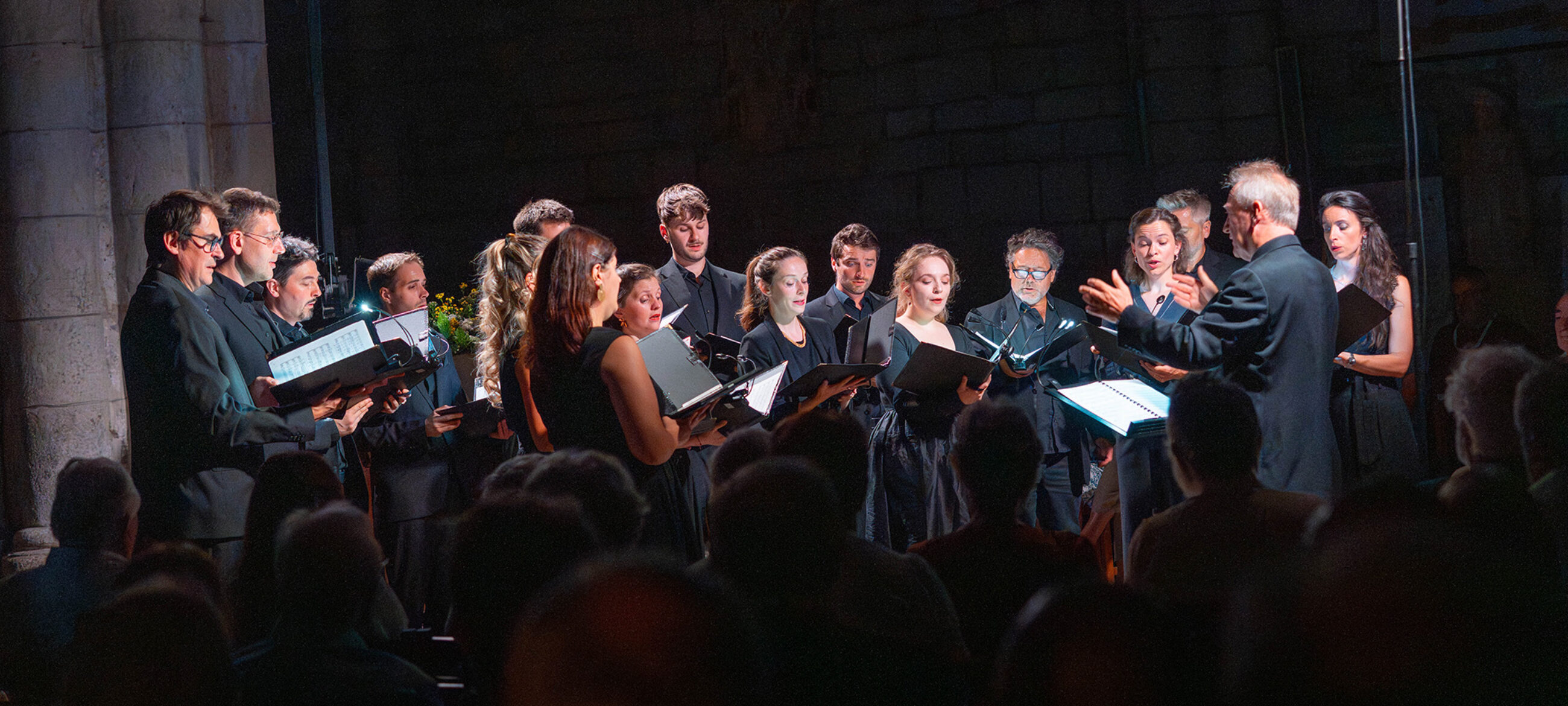
Cantus Missae
1:20 Program
Nigel Short conductor
17 singers a cappella

This program offers an immersion into German Romantic choral music, where Lutheran spirituality blends with a new expressiveness inherited from J.S. Bach.
At the center, Josef Rheinberger’s Cantus Missae, a pinnacle of 19th-century a cappella Mass composition, unfolds a mastery of counterpoint and harmonic richness that combines liturgical fervor with Romantic lyricism. Surrounding this central work, Reger, Brahms, and Mendelssohn revisit the motet tradition, imbuing it with unprecedented harmonic density and dramatic tension. The motets of J.S. Bach, serving as structural and spiritual models, frame the program, affirming the continuity of a centuries-old polyphonic heritage. Finally, Rudolf Mauersberger’s lament Wie liegt die Stadt so wüst provides a tragic extension, bearing witness to the persistence of the sacred in the heart of the 20th century. This is a journey where sonic theology, contrapuntal architecture, and emotional depth meet.
Max Reger (1873 – 1916) Der Mensch lebt und bestehet, op.138 n°1
Félix Mendelssohn (1809 – 1847) Mein Gott, warum hast du mich verlassen?, op.78 n°3
Joseph Rheinberger (1839 – 1901) Messe en mi bémol majeur « Cantus Missae », op.109
Jean-Sébastien Bach (1685 – 1750) Komm, Jesu, komm, BWV 229
Max Reger (1873 – 1916) Nachtlied, op.138, n°3
Johannes Brahms (1833 – 1897) Warum ist das licht Gegeben?, op.74 n°1
Rudolf Mauersberger (1889 – 1971) Wie liegt die Stadt so wüst?
Félix Mendelssohn Denn er hat seinen Engeln befohlen über dir, MWV B. 53
Johannes Brahms Drei motetten, op.110
Jean-Sébastien Bach Singet dem Herrn ein neues Lied, BWV 225